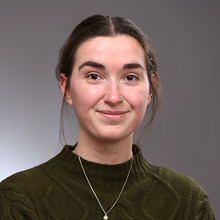
Jaclyn Olberding, a training grant recipient in the Iowa Institute for Oral Health Research and a PhD student in the Interdisciplinary Graduate Program in Genetics, has been awarded an NIH F31 grant to support her dissertation research.
An F31 award is a Ruth L. Kirschstein National Research Service Award that provides support for mentored dissertation research training. The award will support Jaclyn Olberding's investigation into the molecular mechanisms that pattern tissues of the developing lower jaw and give rise to oral tissues, teeth, and skin.
Craniofacial anomalies are the second most common structural malformations present at birth. Despite their prevalence, many of the molecular processes that guide normal craniofacial development remain poorly understood, limiting efforts to develop effective prevention and treatment strategies. Olberding's research seeks to address this knowledge gap by investigating how distinct genetic programs interact during development of the mandible, or lower jaw.


Drawing from research in the laboratory of her mentor, Eric Van Otterloo, associate professor of periodontics, and his collaborator, Huojun Cao, association professor of endodontics, Olberding is studying how tissues along the oral-aboral axis of the developing jaw are specified into oral mucosa, teeth, and skin. Recent work from the laboratory has identified distinct transcription factors and signaling pathways that define these developmental domains and help establish normal tissue patterning.
Her dissertation project will determine how the transcription factors SOX2 and TFAP2 interact to regulate mandibular development and how the SHH and WNT signaling pathways contribute to tissue patterning across the oral-aboral axis. To address these questions, she will employ genome-wide and epigenome-wide molecular approaches, biochemical assays, mouse genetic models, and ex vivo embryonic culture systems.
"We're still learning how the tissues that form the mouth, teeth, and surrounding skin are specified during development,” Olberding said. “By understanding the molecular signals that guide these decisions, we hope to uncover new insights into craniofacial birth defects and identify pathways that could support future regenerative therapies."
"An F31 award recognizes both the scientific significance of the research and the promise of the trainee conducting it,” Van Otterloo explained. “Jaclyn has developed an outstanding project that addresses fundamental questions in craniofacial biology while providing exceptional training in genetics, genomics, and developmental biology.”
This project is the ninth NIH training grant that students in the college’s training grant program have secured since the training grant was renewed in 2018, and the third since the training grant was refunded in 2023. Past trainees who received NIH training grants include Aline Petrin (K01), Jennifer Sukalski (F31), Matthew Remy (F31), Jason Semprini (F31), Tim Nguyen (F31), Mason Sweat (F32), Rachel Fitzjerrells (F31), and Samantha Wuebker (F31).
Research reported on this website is supported by the National Institute of Dental and Craniofacial Research of the National Institutes of Health under Award Number F31DE036431. The content is solely the responsibility of the authors and does not necessarily represent the official views of the National Institutes of Health.