
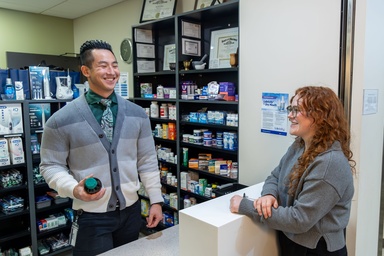
Matthew Yeates, PharmD, is a clinical pharmacist at the University of Iowa College of Dentistry and Dental Clinics, where he works in the fully embedded pharmacy, located on the third floor of the Dental Science Building near the Family Dentistry clinic, serving dental patients, faculty, and students. In this conversation, Yeates discusses the pharmacy’s role in education, patient care, and customized treatment.

What is your role as one of the embedded pharmacists?
There are two embedded pharmacists at Iowa Dentistry—Amy Greenwood, PharmD, and myself. We run a fully patient-facing, independent pharmacy within the College. We dispense medications to dental patients for acute scenarios post-operatively and manage dental patients with chronic mucosal diseases or high fluoride treatment needs. Additionally, we accept and fill prescriptions for anyone with medication needs.
Beyond dispensing, we teach across the dental curriculum—from first-year students to residents—and encourage consultation rather than managing drug therapy alone.
Alumni nationwide still contact us with questions, and we’ve historically given continuing education presentations across Iowa, the Midwest, and internationally.
This model is unique; to the best of our knowledge, no other college of dentistry in the U.S has a fully functional pharmacy embedded in their clinics that is managed and staffed by clinical pharmacists.
Why is the onsite pharmacy so valuable?
It enables true interprofessional care. Dentists prescribe medications, but they also treat patients who are already taking a complex list of drugs. We help dental clinicians understand what they’ll actually see in day-to-day practice and how to manage that safely. We also perform non-sterile, non-hazardous compounding—customizing formulations, removing allergens, improving tolerability, and creating more effective treatments.
Timeliness is also a major advantage—patients can fill prescriptions immediately after procedures without long waits. For example, following oral surgery, prescriptions are sent directly to us while patients are still in the chair. By the time they’re discharged, they leave with medications in hand and counseling complete.
What difference does this make for patients?
At other pharmacies, miscommunications or delays are common, often increasing patient wait times. That gap between prescription and treatment can slow relief and frustrate patients. Here, because we can access both dental records and pharmacy systems, we troubleshoot immediately, eliminating frustration and improving outcomes.
What types of compounded medications do you use most often?
Compounded medications are custom prescriptions—pharmacists make them specifically for a patient when the usual, commercially available options don’t quite work. In our practice, we most often use compounded mouthwashes for mucosal diseases such as lichen planus, oral candidiasis, and aphthous ulcers that don’t respond to commercial products. We also create topical treatments that adhere better to oral tissue and transdermal preparations for temporomandibular disorder (TMD) pain, providing local relief without systemic side effects. I came from a compounding background, so I really enjoy that work.
Currently, we’re developing our own dental gel for patients with sensitivities or reactions to commercial products. We’ve tested several versions, adjusting texture, taste, and feel to ensure effectiveness and comfort.
How do you support patients with mail-order prescriptions or lower-cost alternatives?
Many patients are not local, so we provide mail service and ship to Iowa and Illinois. For compounded medications, we we offer competitive pricing for our commonly requested products including commercially available over-the-counter or prescription drugs, compounds, or dental devices.
What do you enjoy most about working in a dental college setting?
I enjoy preventive therapy and the creative aspect of compounding—it’s like cooking, experimenting with formulas to create products that patients want to use. The most rewarding moments are when patients return and say, “This completely resolved my mouth sores,” or “My pain is gone.” They invested in their care, and we delivered something effective.
What about teaching and mentoring students?
Teaching dental students is newer to me, but I emphasize that pharmacists are part of their care team. We help students navigate complex cases and understand when to consult a pharmacist, reinforcing collaborative, interprofessional care.
And finally, is there a moment that really captures why this work matters to you?
One memorable example is a patient with chronic aphthous ulcers (canker sores). We tried changing toothpaste – no luck. We tried steroid gel, which helped a bit. Ultimately, we used a pharmaceutical-grade glutamine supplement to help the oral tissue heal. The problem resolved completely. Months later, the patient said, “I forgot I even had that issue.” That’s the outcome we want: durable, meaningful improvement.